- crypto still makes people juggle seed phrases, gas tokens and bridges. near built the fix most chains only have on a slide.
- chain signatures (live since 2024) let one near account sign for bitcoin, ethereum, solana and more, with no bridge and no wrapped assets.
- near intents lets you say what you want to end up holding and solvers compete to fill it. more than $27.5b had settled through it as of september 2026.
- since february 2026, intents fees buy near on the open market, tying the busiest product to the token.
- founder illia polosukhin co-wrote attention is all you need, and he's betting ai agents become blockchain's main users. near's rails are built for exactly that.
try explaining a crypto wallet to someone who does not already own one.
they need a seed phrase, which they must write down and never lose and never show anyone. they need a gas token on the right chain, which they cannot buy without already having the gas token. they need to understand that their money lives on one network and the thing they want lives on another, and that moving between the two means a bridge, and that bridges are where most of the money in this industry has been stolen.
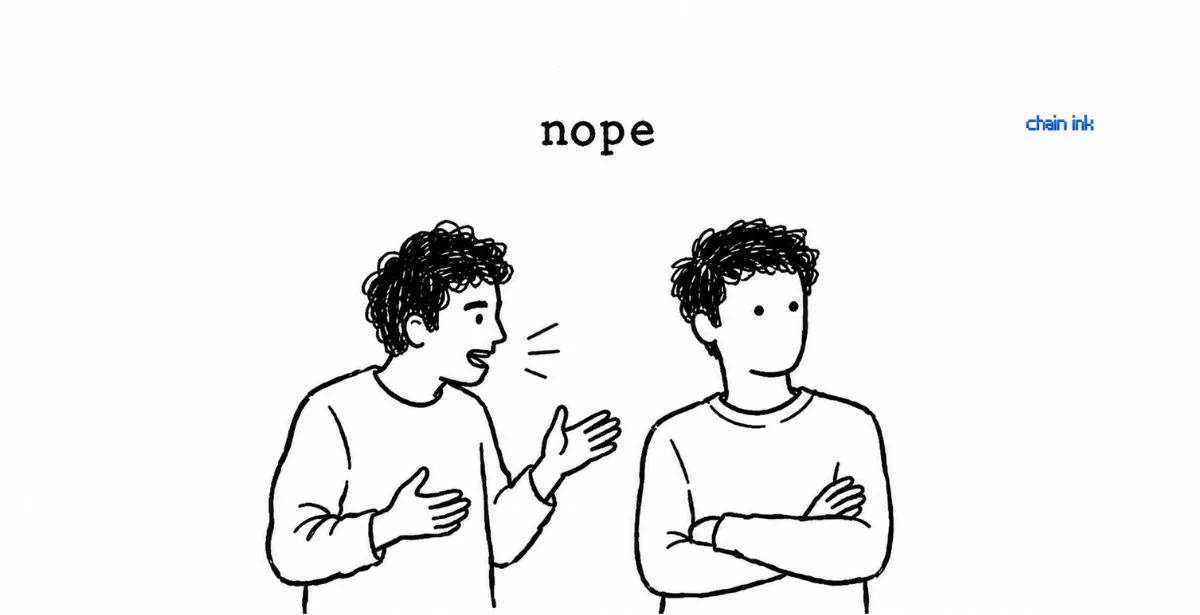
somewhere in that explanation the person stops listening. every chain in crypto has watched it happen for a decade, and every chain has a slide about fixing it.
the promise everyone makes
the industry's name for the fix is chain abstraction.
the pitch is that a user should never have to know which network they are on, which token pays the fee, or what a bridge is. state what you want and let the plumbing figure it out. it has been on roadmaps since roughly 2023, and it is one of those ideas that sounds obvious and turns out to require rebuilding a lot of things underneath.
as of september 2026, most of the industry was still on the roadmap. one chain went and built it, and the numbers are considerably larger than the attention.
what near actually shipped
two pieces, and the order matters.
the first is chain signatures, live since 2024. a single near account, or a smart contract on near, can produce valid signatures for addresses on other networks through a decentralised threshold signing network. bitcoin, ethereum, solana, cosmos, ton, xrp, dogecoin, stellar, sui, aptos. no bridge in the middle, no wrapped version of the asset, nobody custodying the original. one account controlling addresses across a dozen chains, with the signing itself split across a network so no single party holds the key.
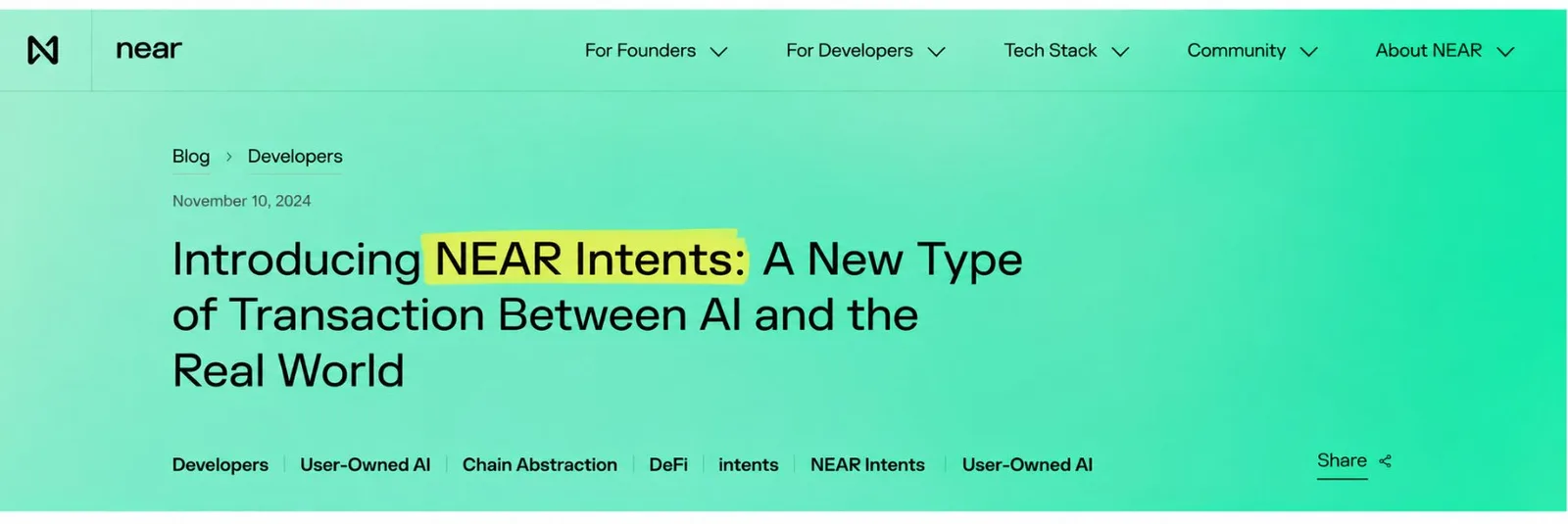
the second is near intents. instead of submitting a transaction that specifies exactly how something should happen, you declare what you want to end up holding. solvers and market makers compete to fill it, and settlement runs atomically through a verifier contract, so the whole thing completes or none of it does.
a transaction says do this. an intent says get me here.
put those together and the user experience changes shape. you do not bridge, you do not hold a gas token for a chain you have never used, and you do not pick a route. you say what you want.
the number
intents is where the theory turned into volume, and the trajectory is the part worth sitting with.
five billion dollars of cumulative volume in november 2025. ten billion by the middle of january 2026. fifteen billion by march. twenty billion by june. as of september 2026, defillama showed more than twenty seven and a half billion dollars across roughly twenty five million swaps, with cumulative fees near forty seven million dollars.
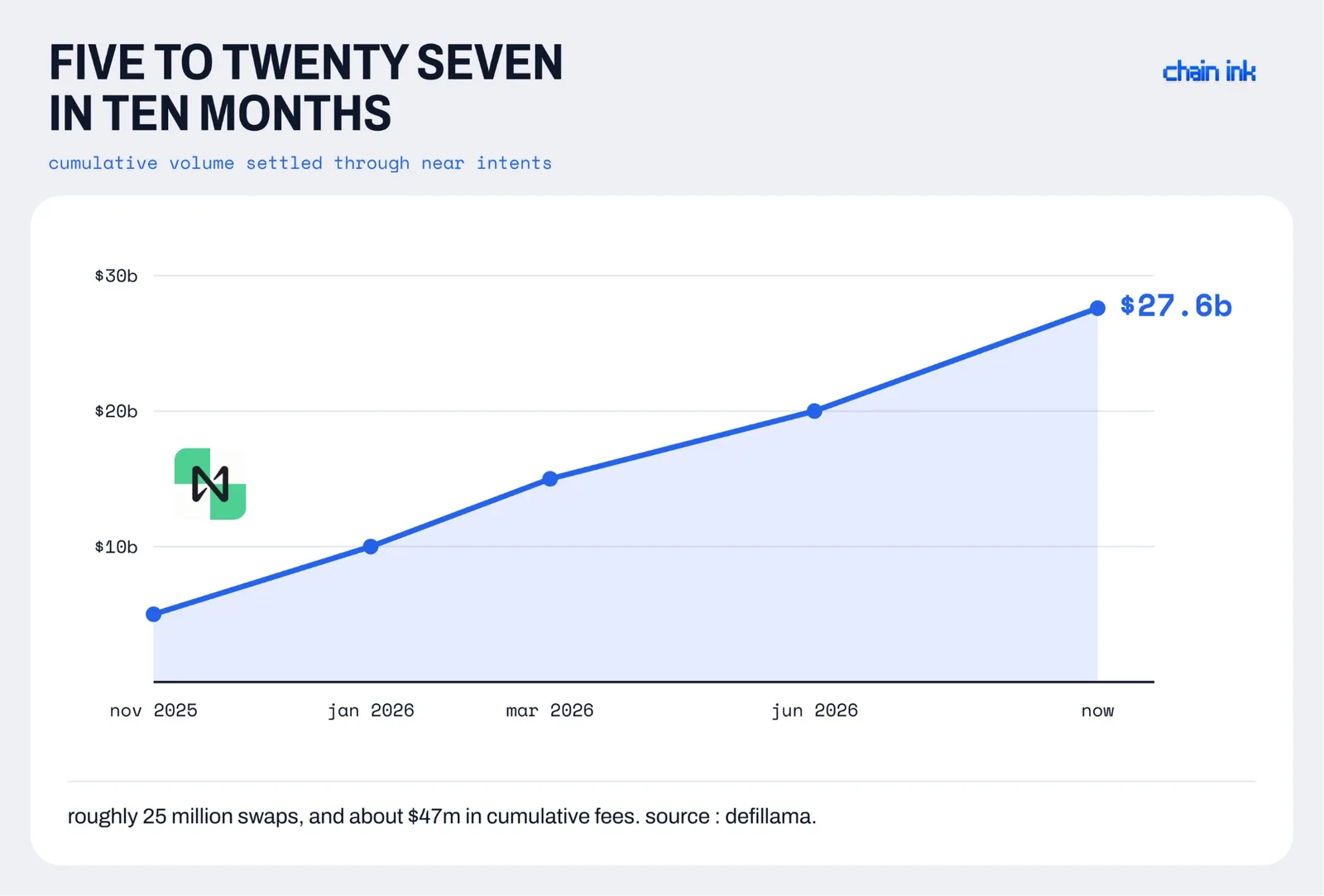
that is not a testnet figure or a grant-funded number. it is people moving real money across chains because the route was cheaper and simpler than the alternative.
in march 2026 brave integrated it directly into its wallet, putting intents in front of a browser with a very large installed base. confidential intents shipped the same month, adding private execution for anyone who does not want their order flow read.
and in february 2026 near switched on the piece that connects all of it to the token. since then, captured intents fees buy near on the open market rather than simply disappearing, which means the busiest product on the chain feeds back into the asset.
the front door
the same week, near shipped the consumer version of everything above.
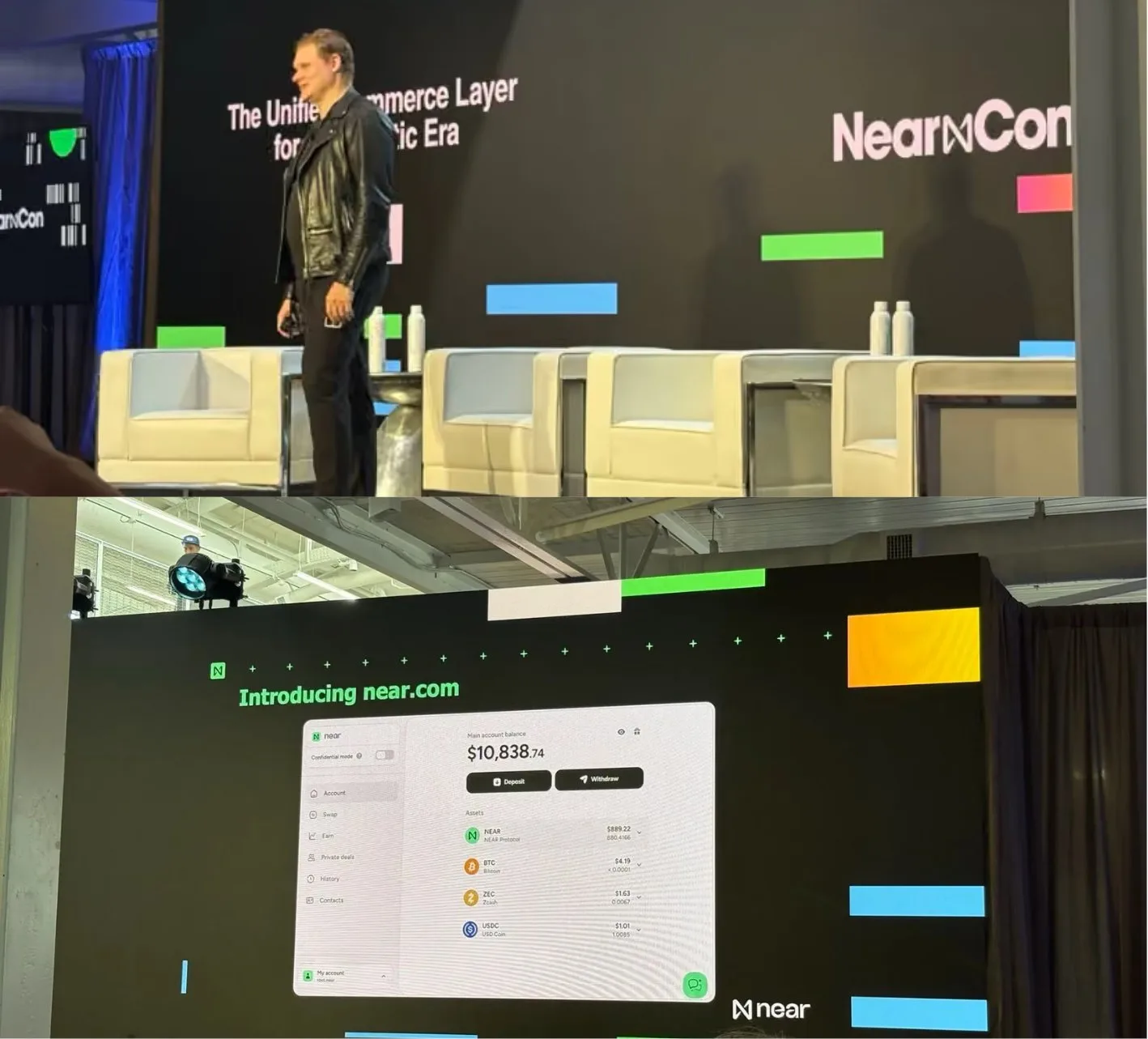
near.com launched at nearcon in february 2026 as a single app that hides keys, gas and thirty five-plus chains behind one account. the entire stack underneath, chain signatures and intents and the shard architecture, exists so that this app can be boring to use.
underneath, the chain itself kept getting quietly better. stateless validation arrived in august 2024, so validators verify a shard without storing its full state, which is how near adds capacity without pushing out smaller operators. blocks land in about six tenths of a second with finality around one point two. the july 2026 upgrade added dynamic resharding, so shards split automatically as state grows, and post-quantum signing using the nist-standardised scheme. as of september 2026, the network had not halted once since october 2020.
the inflation rate was cut in half in october 2025, from five percent to two and a half. as of september 2026, roughly forty six percent of supply was staked across about four hundred validators, and it would have taken eight of them colluding to stop the chain, which is a better decentralisation number than most of its peers can claim.
the man who wrote the paper
all of this gets more interesting when you know who has been pointing it.
near was started in 2018 by illia polosukhin (@ilblackdragon) and alexander skidanov (@AlexSkidanov), and it was not originally a blockchain company. it was a machine learning company that became a blockchain because they needed a way to pay distributed contributors and could not find one that worked.
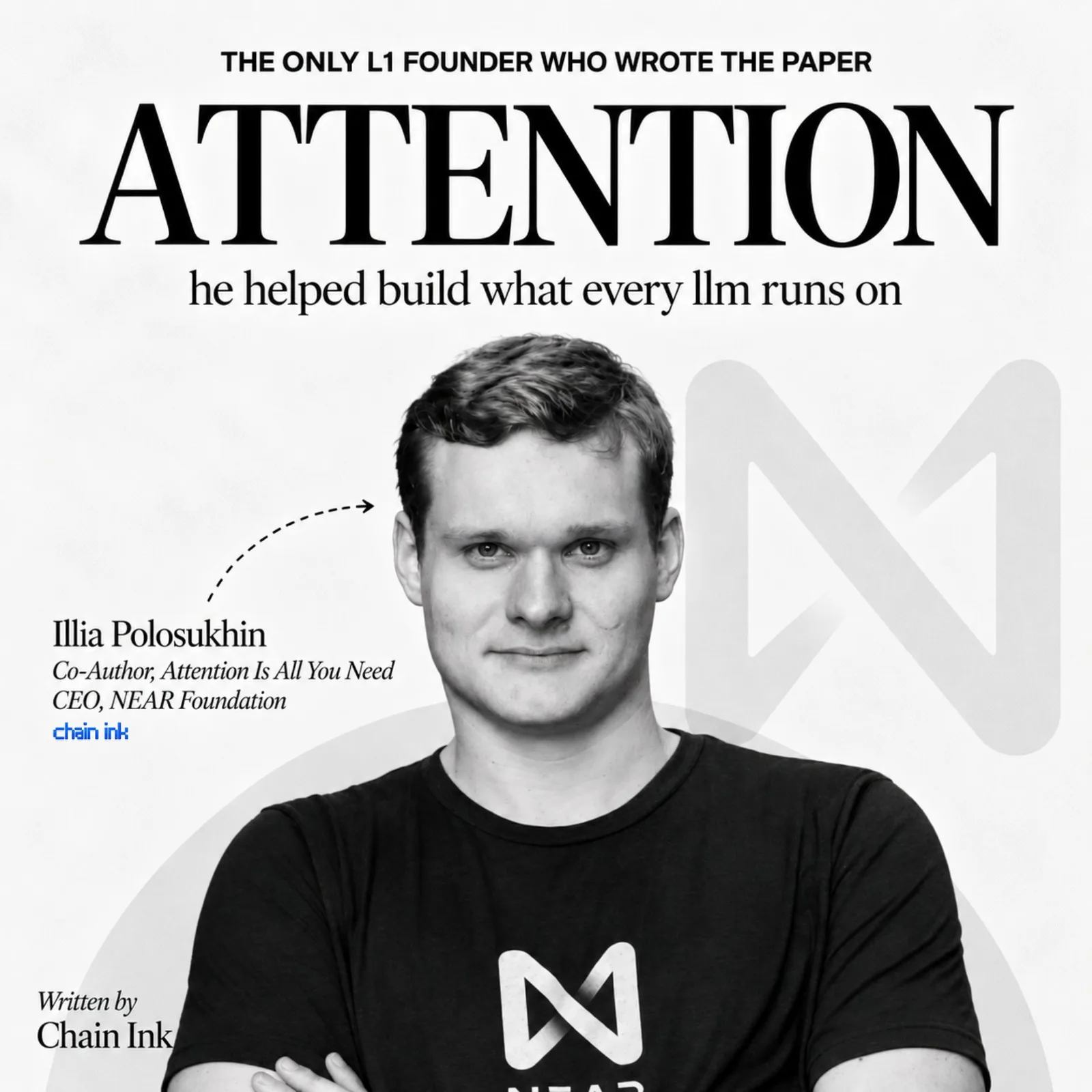
the year before that, polosukhin was one of eight co-authors on a google paper called attention is all you need. it introduced the transformer architecture, which every major large language model is built on, and it had been cited well over a hundred thousand times as of september 2026.
since 2024 he has been making an argument that almost nobody else in this industry is making out loud. in march 2026 he told coindesk that the users of blockchain will be ai agents, and that ai will be the front end while blockchain is the back end.
read the infrastructure again with that in mind and it stops looking like a set of usability features.
an agent cannot hold a seed phrase. it cannot be prompted to approve a transaction. it cannot be expected to know which of forty chains an asset happens to live on. what it can do is state an outcome and let a network resolve it, and sign across chains without a human holding a key. chain signatures and intents were built before the ai framing, and they happen to be exactly what software needs and a person does not.
the ai half
near then built the other end of it.
near ai cloud and private chat launched in december 2025, running inference inside hardware enclaves so that every response carries a cryptographic attestation the user can verify independently through intel's trust authority. the api is drop-in compatible with openai's, which removes the usual reason developers do not try an alternative.

it has real customers rather than demos. brave uses it for confidential inference behind its built-in ai. the government of bermuda built a prototype citizen assistant on it in may 2026. in july 2026 near added a feature letting staked near convert into monthly inference credits, which quietly turns the staking position into a compute subscription.
institutions started showing up around the same time. grayscale filed in january 2026 to convert its near trust into a spot etf on nyse arca under the ticker gsnr, with coinbase custody holding the assets and bank of new york mellon as administrator. bitwise has run a staking etp on deutsche börse since july 2025, which held roughly forty million dollars in assets as of september 2026.
what has to go right
be clear-eyed, because the thesis is ahead of the proof in one specific place.
intents volume is real and growing fast, and as of september 2026, most of it was people and market makers moving across chains rather than autonomous software transacting on its own behalf. that is a good business either way, and it is not yet the agent economy the pitch describes. the bridge between the two is a question of when, not whether the rails exist.
the ai stack launched in december 2025. as of september 2026 it had named customers, a working attestation model and no published usage figures, so it should be read as shipped rather than proven. a dashboard showing real inference volume would change the conversation quickly.
and the activity on the chain needs to broaden beyond the handful of apps that drove most of it as of september 2026, which is the same thing every young network has to solve.
none of that is priced in.
the next billion
every chain in this industry says it is building for the next billion users, and every one of them means people.
near built the infrastructure for that literally, chain abstraction that actually works, an account model a normal person can use, a consumer app that hides the machinery. then it noticed that the same plumbing is what software needs, and that software does not get tired of seed phrases or give up halfway through onboarding.
more than twenty seven billion dollars had moved through the part that works by september 2026.
the founder making the argument helped write the paper that started the thing he says is coming next.
that is not proof. it is a reason to be paying more attention than the market has been.
the ink verdict
CHECKS OUT
chain signatures and intents are live, the intents volume is on defillama, and the ai cloud has named customers like brave.
CAN'T VERIFY
how much of the volume is ai agents versus people and market makers. no published usage figures for near ai as of september 2026.
WATCH
agents actually transacting on the rails, real inference volume on near ai, and activity spreading beyond the handful of apps driving it.
did this survive your dyor?
tap the heart to fill it with ink. up to 10 drops.

tanishq bodh
runs chain ink from a laptop with 40 tabs open. 39 are whitepapers, one is fpl.