- ai chats hold what you were thinking, not just what you did. the big labs protect that with policies, not architecture.
- venice runs open models on rented decentralised gpus, keeps chat history in your browser, and has no moderation layer between you and the model.
- stake vvv for a daily share of inference, or lock it to mint diem, $1 a day of api credit forever that you can sell, hold or borrow against.
- venice reported $100m+ annualised revenue in august 2026, with a genesis burn of a third of supply and emissions cut to 2m a year.
- the company working and the token capturing it are two different bets. the burn has to outrun emissions and unlocks.
open a chat with an ai and read back what you have asked it.
the symptom you looked up before you told anyone. the business idea you were not ready to say out loud. the message you drafted four times. the thing you were embarrassed to ask a person. a search engine holds a record of what you looked for. a bank holds a record of what you spent. an ai chat holds a record of what you were thinking about, in the hours before you did anything, which is a different category of information entirely.

as of september 2026, roughly a billion people typed into one of these every week, and almost all of it sat on somebody's server.
a policy is not an architecture
the industry's answer to this is reassurance, and the reassurance is sincere.
the large labs publish retention windows, say they will not train on your conversations without permission, and let you toggle history off. all of it is real, and all of it is a promise about what a company will choose to do with data it holds. policies change. companies get acquired. subpoenas arrive. the data being there at all is the thing the policy is written around.
there is a second promise stacked on top, which is that the model will decide what you are allowed to ask. refusal behaviour is a product decision made by a handful of firms, applied identically to a novelist researching a violent scene, a security researcher, a doctor, and someone being weird at 2am. reasonable defaults for a mass product, and not something you get to configure.
so the question worth asking is whether the two can be separated. can you have the capability without the logging, and the model without a stranger's judgement about what you meant.
what venice built
venice's answer is to run open models on hardware it does not own, and to keep nothing.
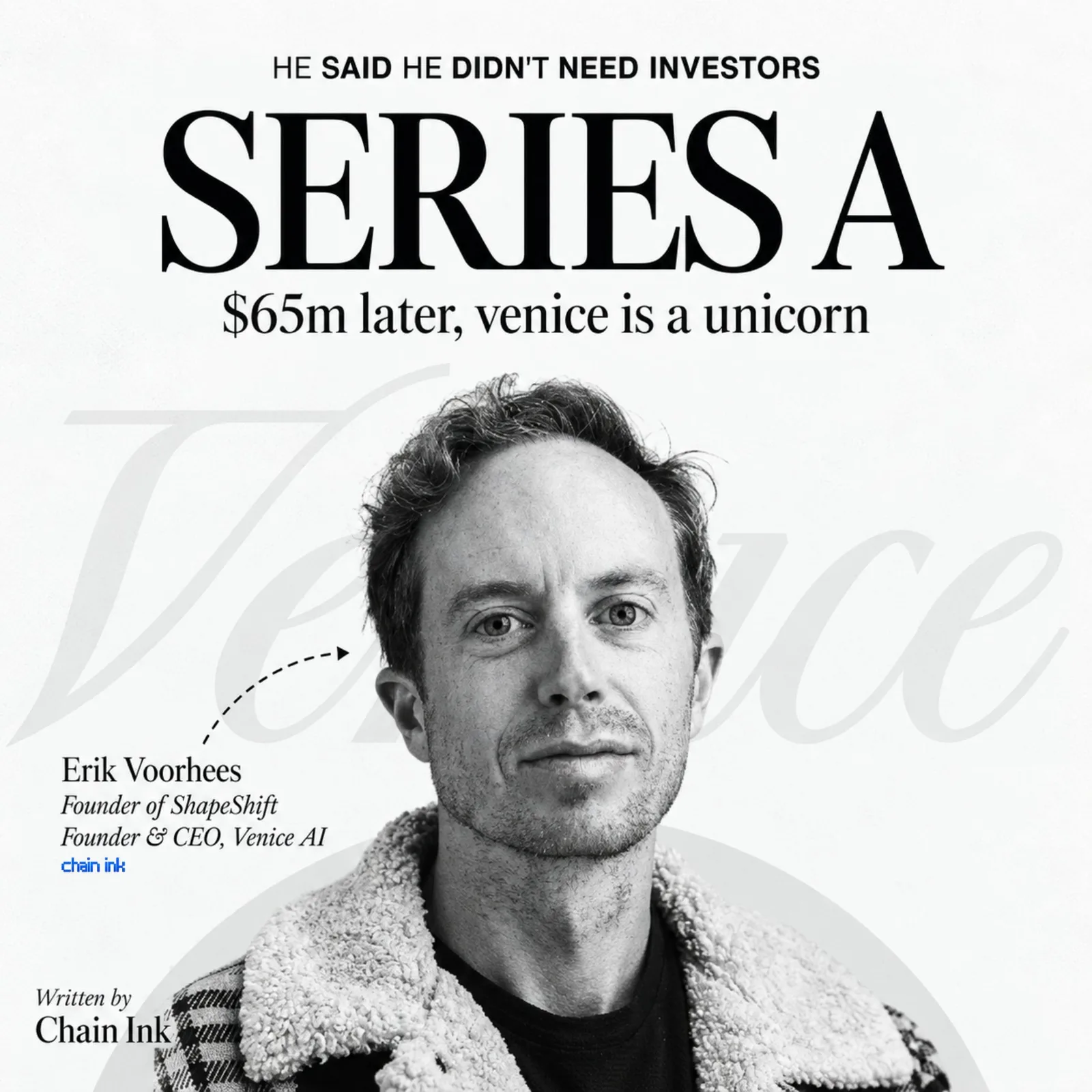
erik voorhees (@ErikVoorhees), who founded shapeshift, started it in may 2024 with teana baker-taylor, previously head of policy and regulatory strategy at circle. the token listed on base in january 2025. voorhees funded the company himself, and the block reported at launch that he was the sole investor and the company had no need for outside money.
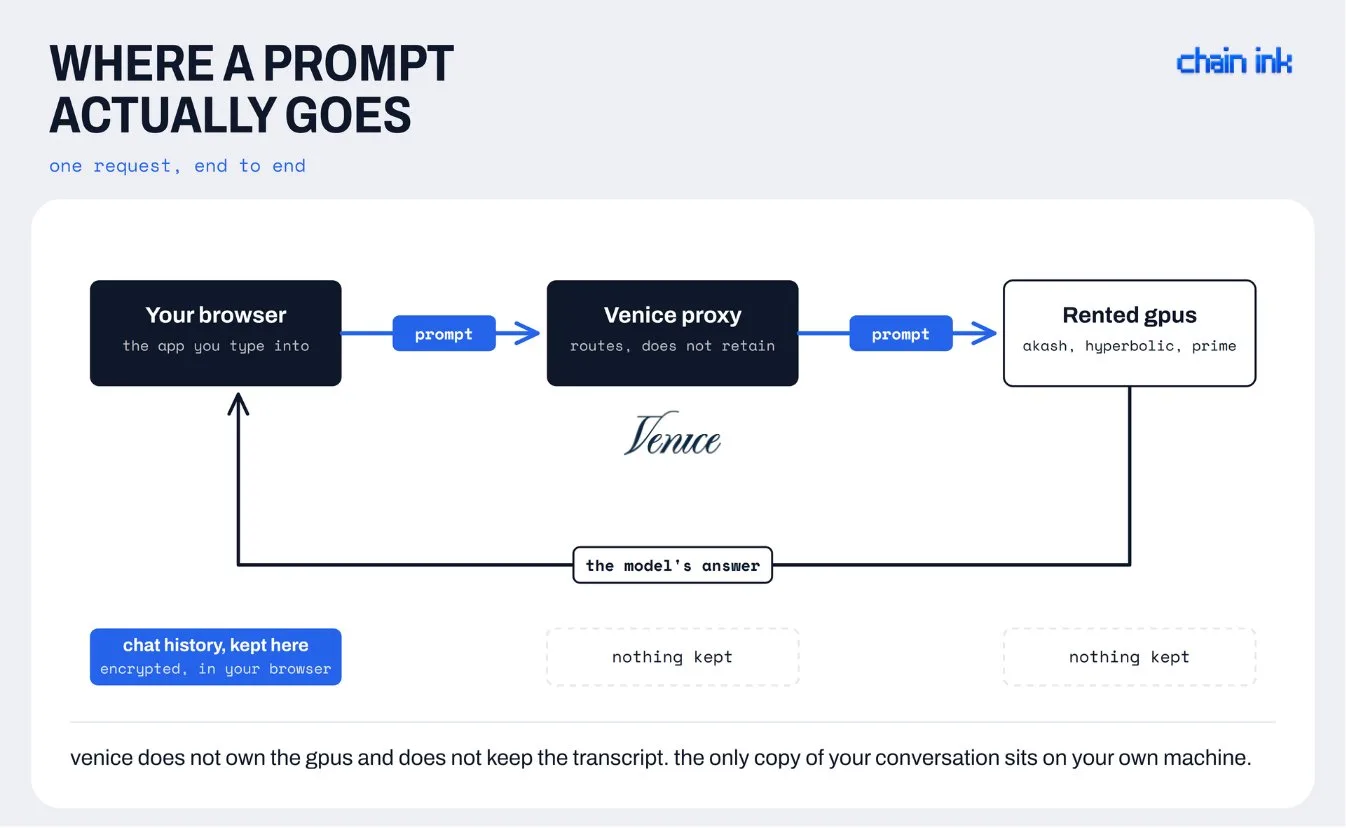
the product is a chat interface and an openai-compatible api running open source models for text, image, code and voice. prompts route over encrypted paths to gpus rented from decentralised compute networks including akash, hyperbolic and prime intellect. conversation history lives in your browser rather than on a venice server. there is no moderation layer sitting between you and the model deciding which questions deserve an answer.
the honest caveat, and venice does not hide from it, is that the core platform code is closed source. the privacy claim is an architectural design rather than something an outsider has independently audited.
the part that is genuinely new
here is where it stops being another ai wrapper and becomes something worth explaining.
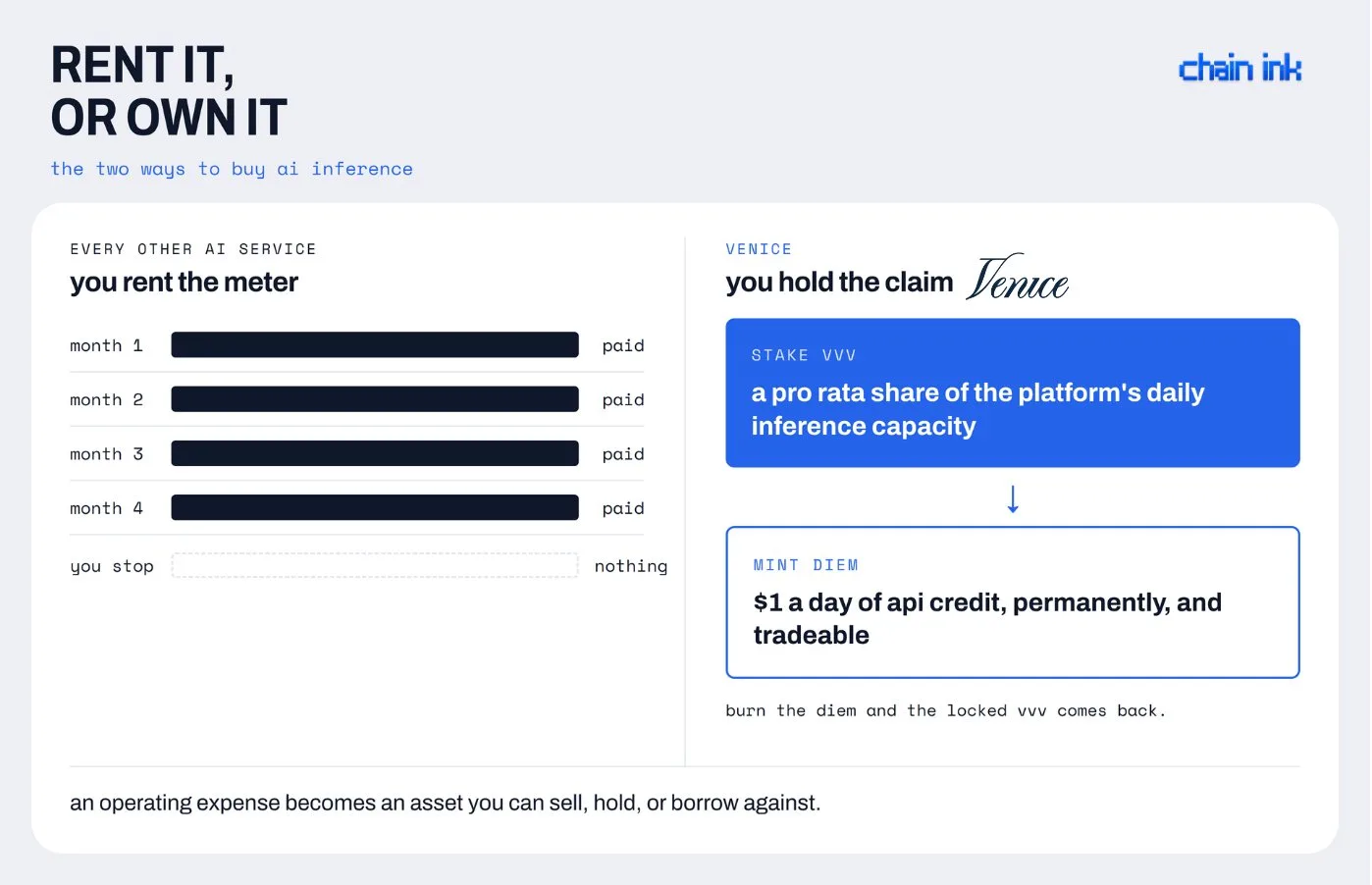
every other ai service bills you per request or per month. you rent access, forever, and the meter runs while you sleep. venice inverted that. stake vvv and you hold a pro rata share of the platform's daily inference capacity, which refreshes every day and costs nothing per call. you are not buying credits. you are holding a claim on a slice of the machine.
then they tokenised the claim itself. diem, launched late 2025, is minted by locking staked vvv, and each one grants a dollar a day of api credit permanently. burn the diem and the underlying vvv unlocks. because each diem is a liability venice has to service, the rate to mint a new one rises as supply grows, which puts a natural ceiling on how much compute can be issued against the token.
a subscription you can sell, hold, or borrow against.
what that does is turn an operating expense into an asset. a developer facing a rising ai bill can fix the cost by owning the capacity instead of renting it. an autonomous agent can hold its own compute rather than needing a card on file. and a vvv holder who does not use the api can sell their allocation to someone who does.
voorhees put the origin of it plainly when diem launched. the number one request from stakers was the ability to tokenize their compute access so the credit itself could be traded.
it is working
the numbers are the part of this story that surprises people.
venice reported crossing a hundred million dollars in annualised revenue in august 2026, up from around seventy million a month earlier, with three and a half million users and roughly 1.3 trillion tokens processed monthly. secondary reporting says the company turned profitable in the first quarter of 2026, which is worth treating as reported rather than confirmed.
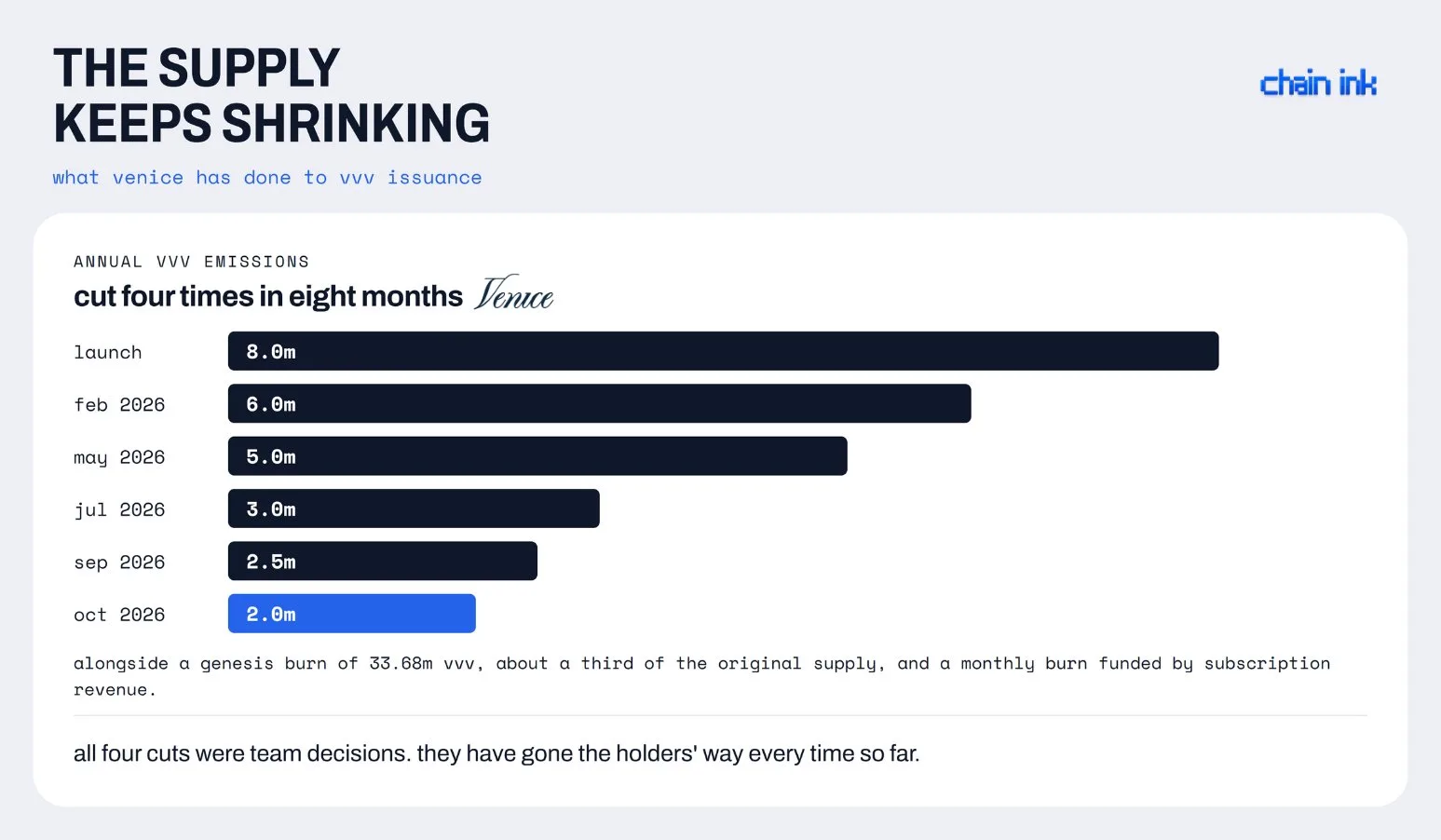
the token economics were tightened alongside it. a genesis burn destroyed 33.68 million vvv, about a third of the original supply. a subscription burn programme uses platform revenue to buy and burn more every month. and annual emissions have been cut four separate times, from eight million down through six, five and three, to two million from october 2026.
and the narrative keeps finding fresh proof. every time a lab has a public dispute about what it stores, who owns the output, or what it refuses to answer, venice's pitch stops being theoretical for a few thousand more people.
what has to go right
be clear-eyed here, because the company working and the token capturing it are two separate propositions.
venice is a company with equity, and vvv is a utility token, and those are different instruments. the company getting more valuable does not automatically move the token. the bridge between them is the burn programme, which means the thesis rests on revenue continuing to grow fast enough to keep buying supply off the market faster than emissions and unlocks put it back.
that second half matters. emissions are falling on a schedule, but as of september 2026 a substantial tranche of supply was still due to enter circulation, and the burn has to outrun it rather than merely keep pace.
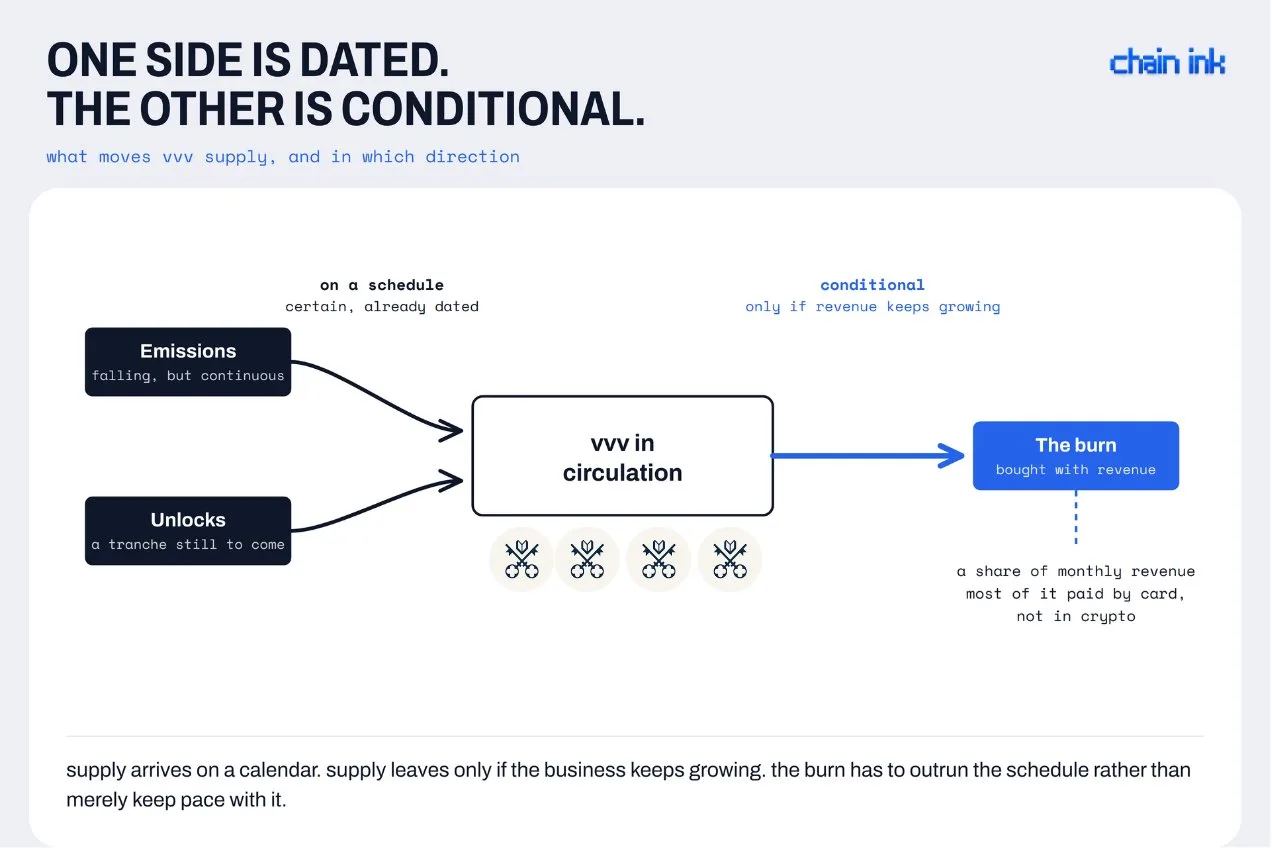
there is also a gap between the platform and the token that the headline numbers hide. as of september 2026, only about eight percent of venice users paid in crypto at all, which tells you how much of the business runs on ordinary card payments that touch vvv only when the monthly burn executes. a user signing up with a credit card is revenue for the company and an indirect, delayed input for the token.
and the governance picture is thin. venice is transparent about being a company rather than a dao, roughly twenty people as of september 2026, with voorhees as founder, funder and primary decision maker. the four emission cuts and the diem launch were all team decisions. they went the holders' way every time through september 2026, which is the point and also the risk.
the meter and the machine
every other way to buy ai is a meter. you feed it, it runs, and when you stop feeding it you have nothing to show for the years you paid.
venice's bet is that inference becomes a thing you can own rather than a thing you rent, and that privacy is the default the system is built on rather than a premium tier. one of those ideas is unusual. both at once, inside a company already reported to be profitable, is close to unique.
the labs will tell you your conversations are safe with them.
this one decided not to have them.
the ink verdict
CHECKS OUT
the product is live and used at scale, diem works as described, and the emission cuts and burns are onchain.
CAN'T VERIFY
the privacy claim, since the core platform code is closed source and unaudited. profitability is reported, not confirmed.
WATCH
revenue outrunning the remaining unlocks, how much of it ever touches vvv when most users pay by card, and decisions staying with a ~20 person team.
did this survive your dyor?
tap the heart to fill it with ink. up to 10 drops.
tanishq bodh
runs chain ink from a laptop with 40 tabs open. 39 are whitepapers, one is fpl.